

The world has obviously been waiting for my take on the Fender intellectual property judgment back in March, so here it is.
A quick recap. Earlier this year (2026) the renowned guitar maker Fender secured a ruling in a German court that a rival firm could not sell unauthorised copies of Fender’s iconic Stratocaster model either in Germany or the wider EU.
This isn’t the first time Fender has sought to protect the intellectual property in its guitars, but it is the first time it has been successful. Its victory, it appears, came about because the latest case was based on copyright rather than trademark law.
Determining that the classic body shape’s design qualifies as an artistic creation and can be protected as such, the ruling has reportedly been interpreted by Fender’s lawyers as applying not just to the losing party in the German court case but to any manufacturer that makes Stratocaster copies and does business in the EU. That’s a lot of guitars – many times more than Fender makes itself.
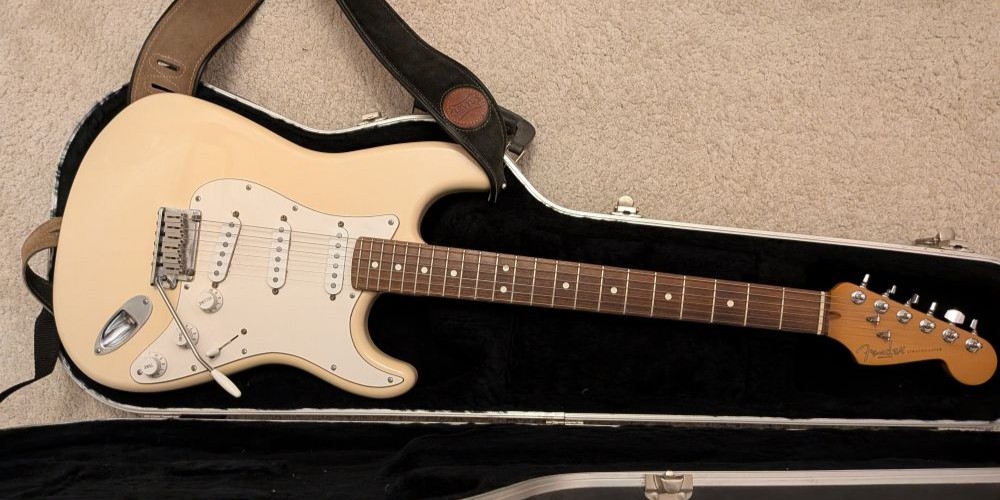
As a PR person and owner, for more than 25 years, of a bona fide USA Fender Stratocaster, I have a few thoughts.
I make my living by creating intellectual property and am keen to see it protected. I understand that for a business like Fender it must be galling to see millions of copies of your design sold every year without gaining any direct financial benefit.
However, there have been Stratocaster copies for decades and I tend to think that the time go in lawyered-up and all-guns-blazing was probably 50 years ago. Waiting generations to enforce your rights just feels vindictive and doesn’t seem to be playing well in the court of public opinion.
Doing Fender’s marketing for them
My other point would be that imitation is the sincerest form of flattery.
My first electric guitar was a Marlin Sidewinder – a Stratocaster copy, bought second-hand as a birthday present in 1988.
In 2000, armed with my very own credit card, I bought myself an actual Fender Stratocaster. Its shape is broadly the same as that of my old Sidewinder but, much as I loved that first guitar, that’s where the similarities end. The Fender is a professional guitar someone (not me, obviously!) could play on a record. It looks great but what you pay for is how it plays and sounds.
However, there are a lot of good, professional-quality guitars out there. The ubiquity of the Stratocaster shape, and the fact young guitar players can pretend they’re Jimi Hendrix with a cheap copy means, I think, that more aspire to own an actual Fender when their abilities and bank balances justify it. Effectively the manufacturers of cheap copies are doing Fender’s marketing for it.
If Fender uses the judgement in the way it appears to want to and stops the next generation growing up playing Strat copies then there is a danger they won’t dream of owning the real thing later on.
The Squier factor
Of course, Fender do have their own “entry level” subsidiary, Squier, a purveyor of official Stratocaster copies which it probably hopes will be the main beneficiary of the ruling. And it might be.
The problem is that, while not up to the standard of a higher-end Fender model, some Squiers are pretty qood and, if properly set up, probably authentic enough that many of their owners will think they already own a serviceable Strat and look to another style of guitar entirely (probably made by a different manufacturer) when they can afford to buy a “proper” guitar.
How will all of this work out? Fender appears to want to destroy the market for copies, although some kind of licensing arrangement would at first glance seem like a more sensible way to proceed for all involved. However, I can also understand that you don’t want to license any old rubbish, and equally that the application of minimum standards and an official seal of approval across all Strat copies could fatally undermine Squier’s USP.
My conclusion? I don’t really have one, but I feel sad. The status quo ante might have been frustrating for Fender but it doesn’t seem to have held back its growth.
No music fan enjoys witnessing the unedifying spectacle of musicians pursuing each other in the courts over purported copyright infringement in a melody, and this feels similar.
It’s not rock and roll and I don’t like it.
